
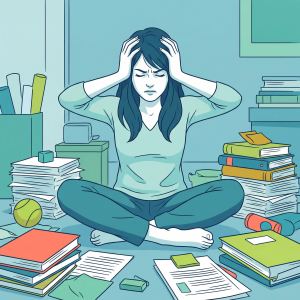
ADHD overwhelm in women is a state of nervous system overload caused by executive dysfunction, emotional intensity, decision fatigue, and accumulated mental load. It can look like freezing in the kitchen, shutting down on the couch, or spiralling over something small — even when you know exactly what needs to be done.
If everyday life feels like “too much” more often than it should, you are not lazy. You are not failing. You may be experiencing ADHD overwhelm.
It’s not one big thing. It’s everything, all at once.
- The emails you haven’t answered.
- The dishes in the sink.
- The appointment you forgot to reschedule.
- The birthday present you meant to buy.
- Everyone needing something from you — while you can’t even decide what to eat for lunch.
Your brain feels like a browser with a hundred tabs open and all of them are loading at once. You know you need to move. But you’re frozen.
This is ADHD overwhelm in women — and it’s neurological, not personal.
What Is ADHD Overwhelm?
ADHD overwhelm is a state of cognitive and emotional overload that occurs when executive dysfunction, time blindness, sensory sensitivity, and daily demands exceed the brain’s capacity to organise, prioritise, and respond. It often leads to freezing, shutdown, emotional flooding, avoidance, or spiralling thoughts.
For neurotypical brains, overwhelm usually follows a major stressor.
For ADHD brains, overwhelm can be triggered by the accumulation of ordinary daily tasks — because each task requires significantly more cognitive effort to manage.
It’s not that you can’t handle big things.
It’s that the “small” things aren’t small for your brain.
Why ADHD Makes Women Feel Overwhelmed So Easily
Executive Dysfunction Overload
Executive function controls planning, prioritising, task initiation, working memory, and switching between tasks. In ADHD, these systems require conscious effort.
When demands pile up, there’s no cognitive reserve. The system doesn’t slow gradually — it crashes.
The Invisible Mental Load
Women disproportionately carry the cognitive load of:
-
Scheduling
-
Household management
-
Emotional labour
-
Remembering for everyone
-
Anticipating needs
For an ADHD woman, whose working memory is already unreliable, this isn’t just tiring. It’s crushing.
Decision Fatigue
Every decision costs energy:
-
What to wear
-
What to cook
-
Which task to start
-
How to respond
-
Whether you forgot something
By midday, your decision-making capacity may already be depleted.
When you can’t decide, you freeze.
When you freeze, everything piles up.
Sensory Overload
Many ADHD women experience heightened sensory sensitivity:
-
Noise
-
Bright lights
-
Visual clutter
-
Temperature
-
Textures
A messy room isn’t just annoying — it’s cognitively draining. Your brain tries to process everything in your visual field at once.
That drains bandwidth fast.
Emotional Dysregulation
ADHD involves emotional amplification. When overwhelm hits, it isn’t neutral stress. It’s:
-
Shame
-
Panic
-
Frustration
-
Helplessness
Now you’re not just overloaded — you’re overloaded while emotionally flooded.
Time Blindness
With ADHD, everything exists in one undifferentiated “now.”
Deadlines feel equally urgent. You can’t triage. You can’t sequence. Everything feels due simultaneously.
That creates a unique kind of overwhelm where nothing feels manageable.
What ADHD Overwhelm Looks Like
The Freeze Response
You know what to do. You might even have a list.
But you cannot start.
Your body is still. Your brain is racing. This is an ADHD freeze response — a nervous system protection mechanism, not laziness.
ADHD Shutdown
You lie on the couch. Scroll your phone. Watch time disappear.
This is ADHD shutdown — your nervous system disconnecting to protect itself from overload.
The Spiral
One unfinished task triggers:
Three forgotten responsibilities
Which trigger shame
Which trigger a memory
Which trigger tears
All within sixty seconds.
The Rage Clean
Suddenly it’s 11pm and you’re reorganising the entire house.
This is stress discharge — your nervous system trying to burn off overwhelm through action.
The Tears
Crying over lost keys.
It’s never about the keys.
It’s accumulated overload finally releasing.
ADHD Overwhelm vs Typical Stress
| ADHD Overwhelm | Typical Stress |
|---|---|
| Triggered by accumulated small tasks | Triggered by major events |
| Linked to executive dysfunction | Linked to workload |
| Often leads to freeze or shutdown | Often leads to urgency |
| Intensified by hormonal changes | Less hormonally sensitive |
| Can happen daily | Usually situational |
Hormones and ADHD Overwhelm
Oestrogen supports dopamine.
When oestrogen drops:
-
Premenstrually
-
Postpartum
-
During perimenopause
-
In menopause
ADHD symptoms intensify.
Your overwhelm threshold lowers — even if your life hasn’t changed.
This inconsistency isn’t instability. It’s biology.
The Four Stress States: Knowing Where You Are
In the Flourish Model, we teach a framework of four stress states that helps you recognise overwhelm before it swallows you:
1. Rest — Your body is regulated and calm. You feel safe, steady, and at ease.
2. Engaged — Your body is still regulated, but with more energy. You feel focused, curious, and connected.
3. Stretched — Your body is starting to move toward dysregulation. You may feel tense, edgy, or like you’re holding it together.
4. Overwhelmed — Your body is fully dysregulated. You may feel flooded, frozen, scattered, shut down, anxious, or spiralling.
The key insight: overwhelm doesn’t happen suddenly. There are signals at the “stretched” stage — tension in your body, racing thoughts, irritability, difficulty concentrating — that tell you your system is approaching its limit. Learning to catch yourself at “stretched” and respond with care is how you prevent the crash into overwhelm.
Your body is always sending signals. But for many ADHD women, those signals are easy to miss — especially if you were praised for pushing through and called “lazy” when you honoured your limits.
Practical Strategies for ADHD Overwhelm
How to Cope With ADHD Overwhelm
In the Moment (When You’re Frozen)
-
Pick one small task — not the most important, just the easiest.
-
Set a 5-minute timer.
-
Change rooms.
-
Name it: “I’m experiencing ADHD overwhelm.”
-
Move your body.
Movement interrupts freeze neurologically.
Daily Prevention
-
Do brain dumps — get thoughts out of your head and onto paper.
-
Limit your daily priorities to three.
-
Build transition time between tasks.
-
Reduce decision points (meal plans, outfit planning).
-
Protect your mornings with a simple routine.
Structural Changes
-
Use visual systems instead of memory.
-
Try body doubling.
-
Reduce visual clutter.
-
Schedule recovery time as a requirement — not a reward.
ADHD Overwhelm vs ADHD Burnout
ADHD overwhelm is usually temporary.
ADHD burnout is chronic depletion from prolonged overwhelm, masking, and under-support.
Burnout requires deeper restoration and structural change.
Frequently Asked Questions
Why does overwhelm hit me so much harder than other people?
Because your brain is doing more work to manage basic tasks. Executive function challenges mean that planning, organising, prioritising, and switching between tasks all require conscious effort that neurotypical brains handle automatically. Your overwhelm is proportional to your actual cognitive load — which is significantly higher than what people see from the outside.
Is ADHD overwhelm the same as burnout?
They’re related but distinct. Overwhelm is usually a state — it builds and can resolve relatively quickly with support and reduced demands. Burnout is the cumulative result of chronic overwhelm over time — a deeper depletion that takes much longer to recover from.
My partner says I’m “making a big deal out of nothing.” How do I explain this?
Try: “My brain processes daily tasks differently than yours. Things that feel automatic for you require conscious effort for me. By the end of the day, I’ve used significantly more cognitive energy — and sometimes the system hits its limit. It’s not about the size of the task; it’s about the cumulative load.”
Can medication help with overwhelm?
ADHD medication can improve executive function, which may raise your threshold for overwhelm. Many women find that medication creates more cognitive “bandwidth” for daily demands. However, medication doesn’t eliminate overwhelm if your life is structurally unsustainable — the accommodations and lifestyle changes matter too.
You’re Not Failing at Life. You’re Running a Marathon in Shoes That Don’t Fit.
The overwhelm you feel is real. It’s not a reflection of your capability, your intelligence, or your worth. It’s the predictable result of an ADHD brain navigating a world designed for a different kind of mind — often without accommodations, often without support, often while carrying the invisible labour of everyone around you.
You don’t need to try harder. You need to carry less. And you deserve help putting some of it down.
At Flourishing Women, we help ADHD women move from overwhelm to sustainability through the Flourish Empowerment Model. With practical strategies, nervous system education, and a community that truly gets it, you don’t have to carry it all alone. Learn about our coaching and support groups.