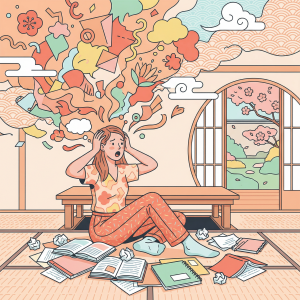
Your to-do list is running in the background of your mind like a browser with fifty open tabs. You’re replaying a conversation from three days ago while simultaneously worrying about something that hasn’t happened yet. Your chest feels tight. Your thoughts won’t slow down. You can’t tell if you’re forgetting something important or if the dread is just… there, for no reason.
Welcome to the intersection of ADHD and anxiety — a place where many women with ADHD live but few people talk about honestly.
If you’ve been told you “just” have anxiety, there’s a good chance that’s only half the story. And if you’ve been treating anxiety without addressing the ADHD underneath it, you’ve probably noticed that the anxiety never fully goes away.
That’s because for many women, the anxiety isn’t a separate problem. It’s a response to living with an unrecognised, unsupported ADHD brain.
How Common Is the ADHD-Anxiety Overlap?
The numbers are significant. Research suggests that roughly half of adults with ADHD also experience an anxiety disorder. For women, the overlap is even more pronounced. Some studies show that women with ADHD are nearly three times more likely to have an anxiety disorder than women without ADHD.
But here’s what makes it complicated: anxiety in ADHD women isn’t always a separate condition. Sometimes it’s a direct consequence of living with unmanaged ADHD. When you can’t trust your memory, when you’re constantly afraid of forgetting something critical, when you’ve been criticised your whole life for things you can’t control — anxiety is a rational response to an impossible situation.
Understanding which came first — and how they interact — matters, because the treatment approach is different depending on the answer.
Three Types of Anxiety in ADHD Women
1. ADHD-Generated Anxiety
This is anxiety that exists because of your ADHD, not alongside it. It’s the worry that comes from genuinely not being able to trust your own brain:
- “Did I lock the door?” (because you know your memory is unreliable)
- “Am I going to miss this deadline?” (because time blindness is real)
- “What if I say the wrong thing?” (because impulsivity has burned you before)
- “Everyone’s going to find out I’m a mess” (because you’re masking constantly)
This type of anxiety is often the first to improve when ADHD is properly treated. When executive function support reduces the number of balls you’re dropping, the anxiety about dropping them naturally decreases.
2. Co-Occurring Anxiety Disorder
Some women genuinely have both ADHD and a separate anxiety disorder — generalised anxiety disorder, social anxiety, panic disorder, or OCD. These conditions have their own neurological roots and won’t fully resolve with ADHD treatment alone.
Signs that your anxiety might be a separate condition:
- It persists even when your life circumstances are stable and supported
- It includes physical symptoms like panic attacks, nausea, or dizziness
- It centres on specific fears that aren’t directly related to ADHD challenges
- It runs in your family independently of ADHD
3. Anxiety as a Coping Mechanism
This is one of the most misunderstood patterns in ADHD women. Some women have unconsciously learned to use anxiety as a productivity tool. The adrenaline spike of worry creates enough urgency to overcome the ADHD brain’s resistance to starting tasks.
You might recognise this if:
- You can only focus when there’s a deadline creating pressure
- You feel like you “need” a certain level of stress to function
- Relaxation feels uncomfortable or even scary
- When things are calm, you create problems to have something to react to
This pattern is exhausting, but it makes sense. When your brain doesn’t produce enough dopamine to create motivation naturally, anxiety produces adrenaline — which functions as a stand-in. The problem is that running on adrenaline long-term destroys your nervous system.
What ADHD Anxiety Actually Feels Like
ADHD anxiety has a texture that’s different from anxiety alone. It’s not just worry — it’s the collision of an overactive mind and an underresourced executive function system.
The Racing Mind That Can’t Prioritise
Anxiety tells you everything is urgent. ADHD makes it impossible to determine what’s actually urgent. The result: a brain that’s screaming “DO SOMETHING” while simultaneously being unable to decide what to do. So you do nothing — and the anxiety gets worse.
The Overwhelm Spiral
A typical spiral looks like this:
- You notice you’ve forgotten to respond to an important email
- That reminds you of three other things you’ve been putting off
- The shame of falling behind triggers a fear response
- You feel paralysed by the volume of things demanding your attention
- You either freeze completely or throw yourself into something irrelevant (cleaning the kitchen instead of doing your taxes)
- Hours pass. The original tasks remain undone. The anxiety intensifies.
Physical Anxiety Meets Sensory Sensitivity
ADHD brains are often more sensitive to physical stimuli. When anxiety adds its physical symptoms — racing heart, tight chest, shallow breathing — they collide with existing sensory sensitivity to create an overwhelmingly uncomfortable physical experience. Your body feels like a hostile environment.
Social Anxiety Amplified by RSD
If you have rejection sensitive dysphoria alongside anxiety, social situations become a minefield. You’re anxious about how you’ll be perceived, hyper-aware of every micro-expression on other people’s faces, and interpreting neutral signals as threats. After social events, you replay every interaction, searching for evidence that you did something wrong.
Why ADHD Is Often Missed When Anxiety Is Treated First
This is one of the most consequential diagnostic failures affecting women: when you present to a clinician with anxiety symptoms, they treat the anxiety. And the treatment — typically SSRIs and cognitive behavioural therapy — may help somewhat. But it never fully resolves the problem, because the engine driving the anxiety (unrecognised ADHD) is still running.
What Women Often Experience:
- Antidepressants reduce the intensity of anxiety but don’t address the executive dysfunction, forgetfulness, or overwhelm
- CBT teaches coping strategies that require exactly the kind of executive function your ADHD brain struggles with (planning, consistency, habit formation)
- You feel “better” but never “well” — there’s always a baseline of struggle that nothing seems to touch
- You blame yourself for the treatment not working: “I’m not trying hard enough”
If this sounds familiar, it may be worth asking your provider about an ADHD assessment. ADHD treatment doesn’t replace anxiety treatment — but addressing both conditions together often produces dramatically better outcomes.
How the Flourish Model Addresses ADHD and Anxiety Together
At Flourishing Women, we recognise that anxiety and ADHD are deeply intertwined for most of the women we work with. Our Flourish Empowerment Model addresses both simultaneously:
Self-Awareness: Understanding Your Unique Pattern
The first step is mapping your specific ADHD-anxiety interaction. Where does ADHD end and anxiety begin? What triggers the spiral? What time of day is hardest? Which environments amplify both conditions? This isn’t about diagnosis — it’s about knowing your brain well enough to work with it.
We help women develop the practice of noticing: “Right now, is this ADHD overwhelm or anxious worry? Or both?” The answer guides the response.
Self-Compassion: Breaking the Shame-Anxiety Loop
Anxiety feeds on shame. When you’re ashamed of your ADHD struggles, the shame triggers anxiety about being found out, which triggers more masking, which depletes your resources, which makes ADHD symptoms worse, which creates more shame. It’s a vicious cycle.
Self-compassion disrupts this loop. When you can meet your anxiety with “This makes sense given what I’m carrying” instead of “What is wrong with me?”, the entire dynamic shifts. The anxiety doesn’t disappear, but it loses much of its amplifying power.
Self-Accommodation: Reducing the Triggers
Much of ADHD-generated anxiety can be reduced by building an environment and routine that accounts for your brain’s needs:
- External memory systems (calendars, alarms, visual reminders) reduce the anxiety of forgetting
- Buffer time between commitments reduces the time-pressure panic
- Simplified decision-making (meal planning, capsule wardrobe, automated bills) reduces daily cognitive load
- Sensory adjustments (noise-cancelling headphones, dimmer lighting, comfortable textures) reduce the physiological stress that amplifies anxiety
- Exit strategies for social situations give you permission to leave before overwhelm takes over
Self-Advocacy: Communicating Your Needs
Anxiety often prevents ADHD women from asking for what they need — because asking feels vulnerable, and vulnerability triggers both anxiety and RSD. Self-advocacy builds the muscle of making requests despite the discomfort:
- Asking a manager to provide instructions in writing
- Telling a friend “I need to leave early tonight”
- Requesting agenda items before a meeting so you can prepare
- Saying “I’m overwhelmed and I need help” before you’re in crisis
Self-Care: Calming the Nervous System
When both ADHD and anxiety are active, your nervous system is in overdrive. Self-care focuses on practices that regulate the nervous system:
- Sleep hygiene (critical — poor sleep amplifies both ADHD and anxiety)
- Regular movement (helps discharge anxiety while supporting dopamine production)
- Nutrition (blood sugar stability reduces anxiety spikes; protein supports dopamine)
- Mindfulness (even brief practices; doesn’t need to be perfect — ADHD-friendly mindfulness exists)
- Nature exposure (consistently shown to reduce both ADHD symptoms and anxiety)
- Limiting stimulants (caffeine can worsen anxiety even while temporarily helping ADHD focus)
Practical Strategies for the ADHD-Anxiety Combination
When You’re Stuck in a Spiral
- Name both things: “This is my ADHD making everything feel unmanageable, and this is my anxiety telling me it’s an emergency. Neither is the full truth.”
- Pick one thing: Not the most important thing — the easiest thing. Completing one small task breaks the paralysis.
- Move your body: Even 5 minutes of walking can interrupt the freeze response.
- Tell someone: Anxiety grows in isolation. Texting a friend “I’m spiralling” can release the pressure valve.
Daily Management
- Morning structure: Start the day with the same simple routine to reduce decision fatigue before you’re fully resourced
- Brain dumps: When your mind is racing, dump every thought onto paper. You don’t have to organise them — just get them out of your head
- Body check-ins: Set a timer for 3-4 times daily to notice: Am I tense? Am I breathing? Am I hungry? Am I overstimulated?
- End-of-day closure: A brief review of what you accomplished (even the small things) counteracts the anxiety voice that says “you didn’t do enough”
Building Long-Term Resilience
- Work with a provider who understands both conditions — not all therapists or psychiatrists are equipped to treat the ADHD-anxiety intersection
- Join a community of women who share your experience — normalisation is one of the most powerful anxiety reducers
- Address the root beliefs — “I’m not enough,” “I can’t be trusted,” “everything will fall apart” — these beliefs amplify both ADHD struggles and anxiety. Coaching and therapy can help restructure them.
Frequently Asked Questions
Should I treat the ADHD or the anxiety first?
There’s growing clinical consensus that treating ADHD first — or simultaneously — often produces the best outcomes. When the executive dysfunction improves, much of the compensatory anxiety naturally reduces. However, if anxiety is so severe that it prevents you from engaging in treatment, stabilising the anxiety first may be necessary. Discuss the sequence with a provider who understands both conditions.
Can stimulant medication make anxiety worse?
It can, in some cases. Some women find that stimulant medication initially increases anxiety before it settles. Others find that by improving focus and reducing the chaos, stimulants actually decrease their anxiety significantly. This is a very individual experience and should be monitored carefully with your prescriber.
I’ve been on antidepressants for years and I still feel anxious. Could it be ADHD?
Possibly. If SSRIs have helped your mood but you still struggle with concentration, overwhelm, time management, and a persistent feeling of “keeping up but barely” — ADHD is worth investigating. Many women find that adding ADHD treatment to their existing anxiety management creates the breakthrough they’ve been looking for.
Is it possible that I just have anxiety and not ADHD?
Yes, and a thorough assessment can help distinguish them. Key questions to consider: Did your focus and organisational issues exist before the anxiety started? Do you struggle with executive function even during calm periods? Do you experience time blindness, impulsivity, or hyperfocus? These are ADHD markers that pure anxiety wouldn’t explain.
You’re Not Failing at Being Calm. Your Brain Is Working Overtime.
If you’re a woman living at the intersection of ADHD and anxiety, you’re not weak, dramatic, or high-maintenance. You’re managing two neurological realities simultaneously, often without adequate support, while the world tells you to “just relax.”
You can’t relax your way out of ADHD. And you can’t willpower your way out of anxiety. But you can build a life that accounts for both — one where your brain’s needs are honoured, your nervous system is cared for, and you’re surrounded by people who understand what you’re carrying.
That’s not fixing yourself. That’s finally giving yourself what you’ve always needed.
At Flourishing Women, we understand the ADHD-anxiety intersection because so many of the women in our community live it every day. Our Flourish Empowerment Model provides the framework for managing both — with compassion, practical strategies, and genuine community. Learn about our coaching and support groups.